BLG Bellah on the Challenges of Modernity
In the years between publication of his 2011 masterwork, Religion in Human Evolution, and his sudden death in 2013, Robert Bellah was beginning a short but ambitious book on “modernity.” Having ended RIHE with the emergence of the great Axial-age religious traditions in ancient Israel, Greece, China and India, he urgently sought to unravel the deep culture of modernity. He did not reject modernity but sought to understand its contradictions and to awaken the hope that humankind, collectively, could radically redirect its course. He began, as he often did, by engaging foundational texts that allowed him to disentangle and recombine the important threads of a larger argument.
In two public lectures and a Prologue to the book he envisioned as The Modern Project, Bellah engaged the visions of Aquinas and Dante, Calvin and Milton, Goethe and Kant, Tolstoy and Max Weber, as well as the theologian Paul Tillich, the polymath archaeologist/anthropologist Ian Morris, and the social theorist Hans Joas. Bellah was above all seeking sources for a new narrative that could encompass the dueling aspects of modernity: its aspiration toward the equal value of every human being and its relentless drive toward progress without limits. In a world that faced the “hardest of hard ceilings”—the inexorable limits of climate change—he argued, forging a new narrative that could energize a global movement for change was essential.
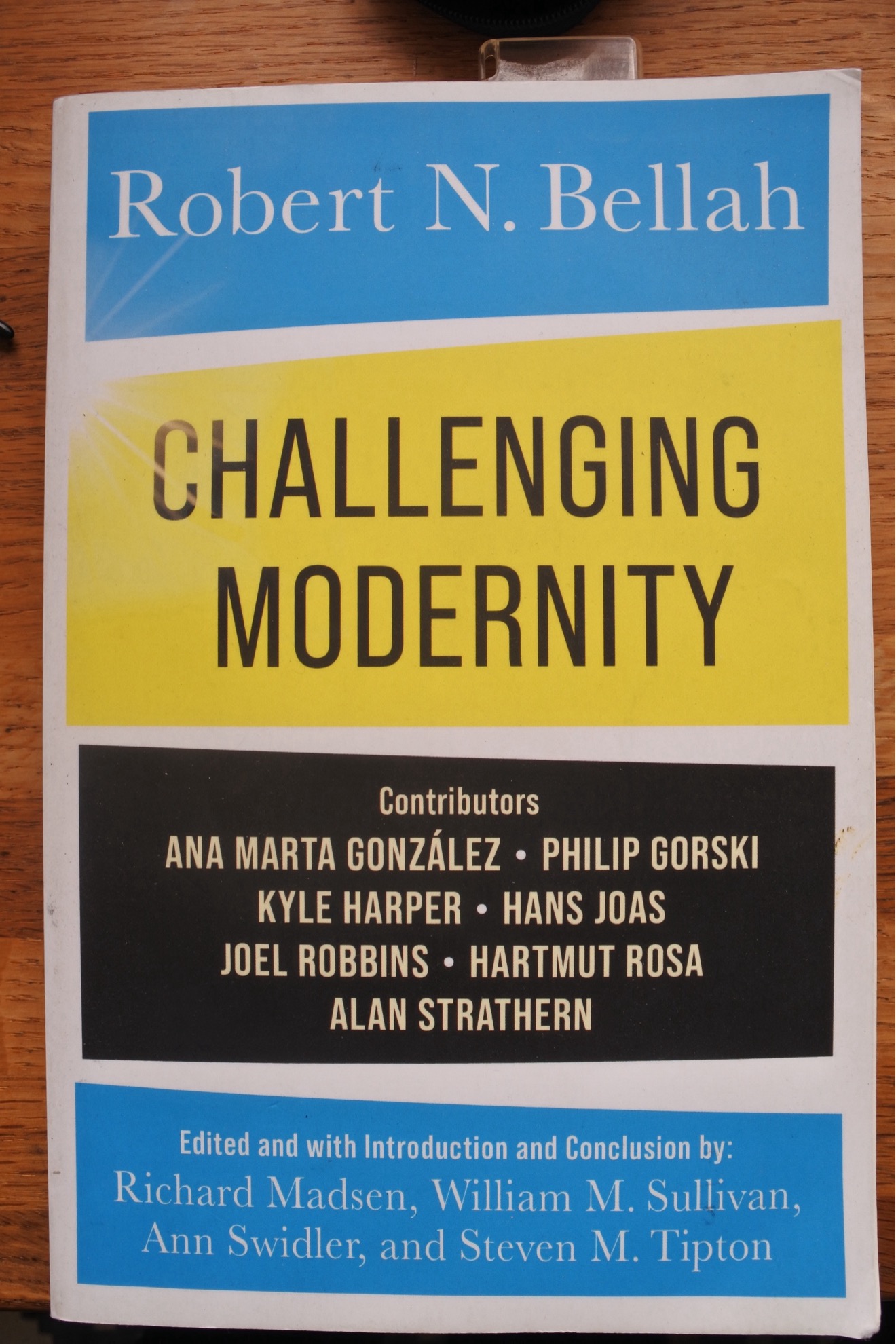
To explore both the historical sources and the future possibilities for these aspirations, in 2021 the surviving authors of Habits of the Heart and The Good Society convened an exhilarating conference on modernity, hosted by the Social Trends Institute in Barcelona. There, major scholars, each profoundly interdisciplinary practitioners of history, anthropology, sociology, philosophy, and social theory addressed the great questions Bellah’s work raised. As we wrote in our introduction to the resulting 2024 volume, Challenging Modernity,
Why, in his magisterial final volume, Religion in Human Evolution, did Bellah begin with the evolution of life on earth and of humankind to frame the story of religion? He was seeking to foreground the interdependent fate we share with all life on the planet. He was reminding us (if we need reminding) that the fate of all humanity, and indeed of all life on earth, is now shared…. In analyzing the symbolic resources that enable transcendence and release the deep wellsprings of human collective action, was he hoping for a new cultural narrative that could break through the confines of late modernity, awaken our common humanity, and allow us to act together to avert our looming fate?
These are the challenging questions that the authors of this volume address. The authors are Bellah’s peers, not his acolytes. This is not a festschrift but rather a collegial engagement of brilliant scholars who share Bellah’s sense of urgency, his broad range of historical and philosophical reference, and his dedication to the human project.
Resources
Here are links to a few representative works of the contributors to Challenging Modernity and of other figures who had a major influence of Bellah approach on modernity:
Ana Marta González is Professor of Moral Philosophy in the Department of Philosophy at the University of Navarra, Spain. Recent works in English include:
The emotions and cultural analysis (2013). Ashgate. ISBN 978-1-4094-5318-5 OCLC 984788453
Kant on culture, happiness and civilization (2021). Palgrave. ISBN 978-3-030-66468-8 OCLC 1246512815
Philip Gorski is Professor of Sociology and Religious Studies at Yale. Recent books include:
with Samuel L. Perry, The Flag and the Cross: White Christian Nationalism and the Threat to American Democracy(Link is external) (2022). New York: Oxford University Press.
American Covenant: A History of Civil Religion from the Puritans to the Present. Princeton(Link is external) (2017). Princeton University Press
Kyle Harper, a historian, is the GT and Libby Blankenship Chair in the History of Liberty, Professor of Classics and Letters at the University of Oklahoma. Recent books include:
Plagues Upon the Earth: Disease and the Course of Human History (2021). Princeton University Press. ISBN-13 : 978-0691230597
The Fate of Rome: Climate, Disease, and the End of an Empire (2017). Princeton University Press. ISBN-13 : 978-0691166834
Hans Joas is Ernst Troeltsch Professor for the Sociology of Religion at the Humboldt University of Berlin and Visiting Professor at the University of Chicago. Recent books in English include:
The Power of the Sacred: An Alternative to the Narrative of Disenchantment (2021), Oxford University Press. ISBN-13 : 978-0190933272
Under the Spell of Freedom: Theory of Religion after Hegel and Nietzsche (2024), Oxford University Press. ISBN-13 : 978-0197642153
Joel Robbins is Sigrid Rausing Professor of Social Anthropology at Cambridge and Fellow of Trinity College. His books include:
Becoming Sinners: Christianity and Moral Torment in a Papua New Guinea Society (2004). University of California Press. ISBN-13 : 978-0520238008
Theology and the Anthropology of Christian Life (2020). Oxford University Press. ISBN-13 : 978-0192583697
Hartmut Rosa is Professor and Chair of General and Theoretical Sociology, Friedrich-Schiller-University, Jena and Director of The Max-Weber-Kolleg, University of Erfurt. Recent books in English include:
Alienation and Acceleration: Towards a Critical Theory of Late-Modern Temporality (2026), Polity Press. ISBN-13 : 978-1509572076
Resonance. A Sociology of Our Relationship to the World (2019), Polity Press. ISBN-13 : 978-1509519910
Alan Strathern is Professor of Global History at Oxford and Fellow of Brasenose College. Recent books include:
Converting Rulers: Global Patterns 1450-1850 (2024), Cambridge University Press. ISBN-13 : 978-1108702102
Unearthly Powers: Religious and Political Change in World History (2019), Cambridge University Press. ISBN-13 : 978-1108701952
A few of the many other scholars who influenced Bellah’s thinking about modernity (in addition to Karl Marx, Emile Durkheim, and Max Weber, who were always there) and some of their key works:
Ian Morris:
Why the West Rules—for Now
The Measure of Civilization: How Social Development Decides the Fate of Nations
S.N Eisenstadt:
Comparative Civilizations and Multiple Modernities
The Origins and Diversity of Axial Age Civilizations
Charles Taylor
A Secular Age
Sources of the Self: The Making of the Modern Identity
Merlin Donald:
Origins of the Modern Mind: Three Stages in the Evolution of Culture and Cognition
A Mind So Rare