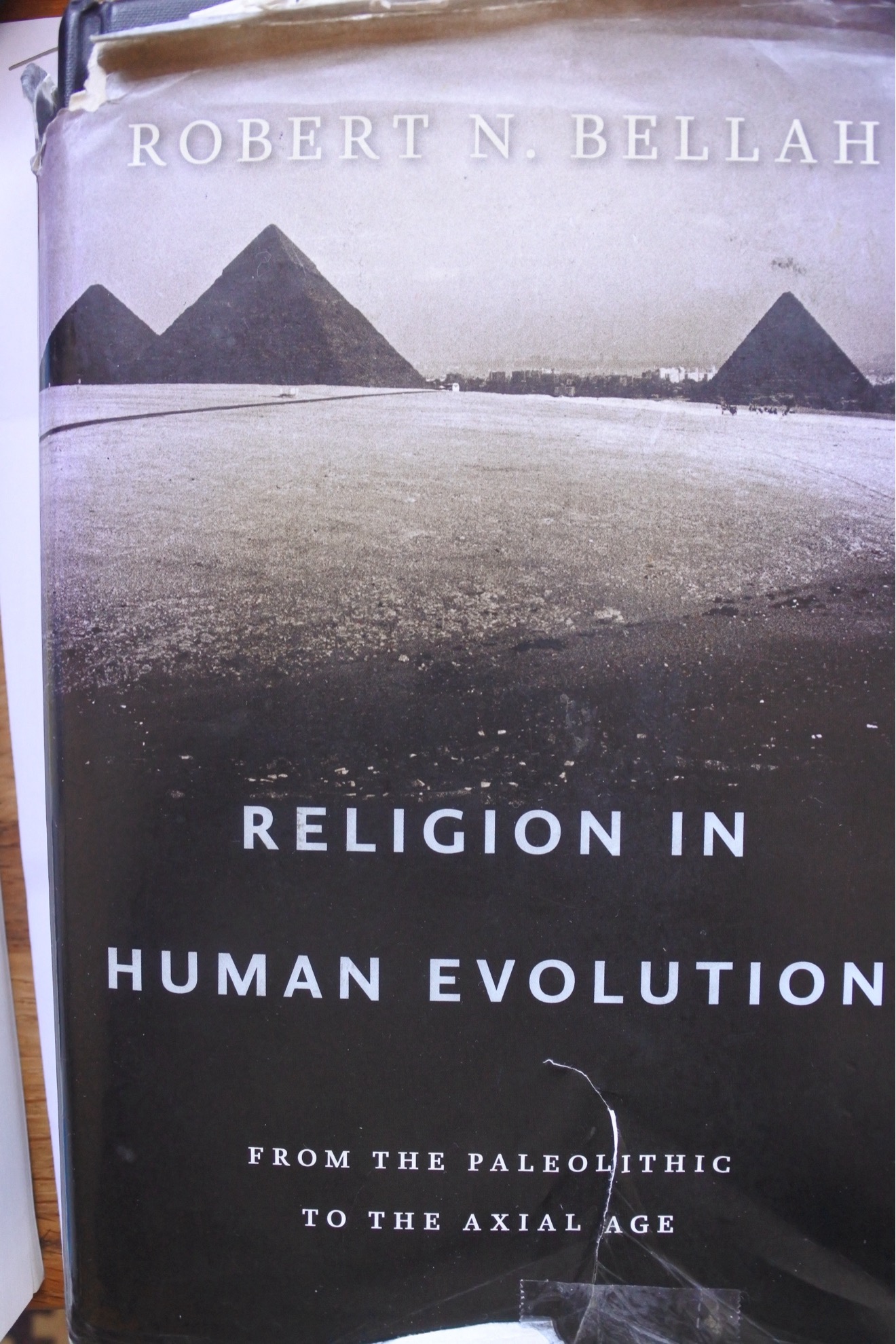
Religion in Human Evolution
Evolution, Religion, and the Human Future:
For Robert Bellah, the theory of evolution provides the necessary framework for a contemporary understanding of religion: evolution “is the only shared metanarrative among educated people among all cultures.” (RHE, p.600) Throughout his career, evolution served as a master framework for Bellah’s sociological work, including not only his culminating study, Religion in Human Evolution: From the Paleolithic to the Axial Age (2011), but earlier as well, in his pathbreaking work on religion as a cultural agency integral to the history of human development. (“Religious Evolution,” 1964, in Beyond Belief, 1970) Bellah understood evolution in the scientific sense as the theory that explains biological diversity as the result of a process of unplanned, contingent selection of variations among life forms, extending over geological eras, which places organisms under constant pressure to adapt to changing environmental conditions. Significantly, Bellah stressed the narrative character of the evolutionary perspective, finding the deep history of humanity within the literally cosmic story of the expansion of the universe since the Big Bang.
In Bellah’s evolutionary thought, humanity is considered as a relatively recent emergent species whose ecological success is a result of its capacities for social cooperation, intensified by learning capacities derived from symbolic, particularly linguistic communication. The prehistory of humanity’s capacity for symbolic thought and action, for construing experience within imaginative worlds of moral significance, can be traced through the emergence of forms of play among mammals that opened evolutionary space for a “relaxed field’ partially free of the pressure of natural selection. Combined with nurture of offspring, this relaxation of selection pressure provided conditions for expanded learning that, in time, supported the elaboration of cultural practices to provide a partial “alternative reality” to the struggle for existence. (RHE, p. 77)
Human society itself, in Bellah’s thinking, is the creation of “constitutive symbols.” By giving sense to shared practices heightened by ritual action, symbolic meanings shape moral norms of cooperation which permit wider solidarity. Here religion emerges as a fundamental dimension of cultural evolution. With religion, the impulse to articulate a sense of the world as a moral whole gains symbolic and enacted, ritualized form, becoming a collective “constitutive symbol” that generates moral order within a meaningful world. “More than anything else,” Bellah noted, religion “is a way of making sense of the world, of forming an identity in relation to the world.” (RHE, p. 102) Moreover, this symbolism of the world as an ordered whole provides the necessary prerequisite for other symbolic forms, such as analytical thinking, including the formulation and testing of scientific theories. In this sense, the religious impulse remains an essential root of cultural evolution. Reciprocally, as social forms have become more differentiated and complex, with social groups increasingly interdependent, religious symbolisms have also become plural and self-reflexive, opening possibilities for the growth of individual personality and social relationship.
In particular, Bellah argued that there had been a marked expansion of human vision and moral understanding over time, especially during the middle centuries of the first Millennium BCE, the so-call, ed Axial Age. This was the era that gave humanity its first visions of universal community and human dignity in the form of the world religions and philosophies of East and West Eurasia. The legacies of this creative era continue to powerfully shape thought and social reality across the world. In more recent centuries, modernity has produced another epochal transformation in ways of living and consciousness, first in Europe and then expanding globally. As Bellah saw it, the development of scientific technology and the emergence of “self-revising” cultural forms such as science and democracy were propelling an even greater transformation of human understanding that raises new hopes and unprecedented concerns about the human future. While both these historical developments represent evolutionary advances, their implications remain deeply ambiguous and contested. Religion in Human Evolution (2011) focuses on the first, Axial Age transformation, while the papers collected in Challenging Modernity (2024) continue Bellah’s long-term exploration of the second, modern transformation.
Evolutionary theory is a form of narrative thinking. It tells a story, as is necessary to make intelligible today’s vastly expanding discoveries about human origins by the natural and social sciences. Robert Bellah stressed the narrative character of evolutionary theory to call attention to its necessary grounding in human society and culture, namely that any account of human development must be formulated from within the story it is attempting to understand and narrate. Thinking about human evolution, then, is ultimately to think as a participant and not simply as an observer. It is to place oneself imaginatively within the story and so share responsibility for where it goes. Since for Bellah, religion expressed symbolically this human embeddedness in the world, religion could also provide a powerful source of cultural energy for engaging with the contemporary threats of global conflict and environmental degradation. Besides culminating in a call for environmental responsibility and social solidarity, Bellah’s evolutionary narrative holds out an urgent invitation to an expanded dialogue about the human future as well as reflection on the past and present.
Further Reading
BLG resources
Richard Madsen, William M. Sullivan, Ann Swidler, Steven M. Tipton (eds.), Challenging Modernity (2024)
“Civil Religion and Public Theology,” in Matteo Bortolini, ed., The Anthem Companion to Robert N. Bellah (Anthem Press, 2019), pp. 63-80.
Resources Beyond the BLG:
Matteo Bortolini, ed., The Anthem Companion to Robert N. Bellah (Anthem Press, 2019), pp. 63-80.
Terrance W. Deacon, Incomplete Nature: How Mind Emerged from Matter (2013)
Merlin Donald, Origins of the Modern Mind: Three Stages in the Evolution of Culture and Cognition (1991)
Joseph Henrich, The Secret of Our Success: How Culture is Driving Human Evolution, Domesticating Our Species, and Making Us Smarter (2016)
Ronald F. Inglehardt, Cultural Evolution: People’s Motivations are Changing and Reshaping the World (2018)
Michael Tomasello, The Evolution of Agency: Behavioral Organization from Lizards to Humans (2022)
Peter Turchin, The Great Holocene Transition: What Complexity Science Tells Us About the Evolution of Complex Societies (2025)
Harvey Whitehouse, Inheritance: The Evolutionary Origins of the Modern World (2024)
David Sloan Wilson, This View of Life: Completing the Darwinian Revolution (2019)
("Resources beyond the BLG" also found in shared folder as "7dii and 7diii....")